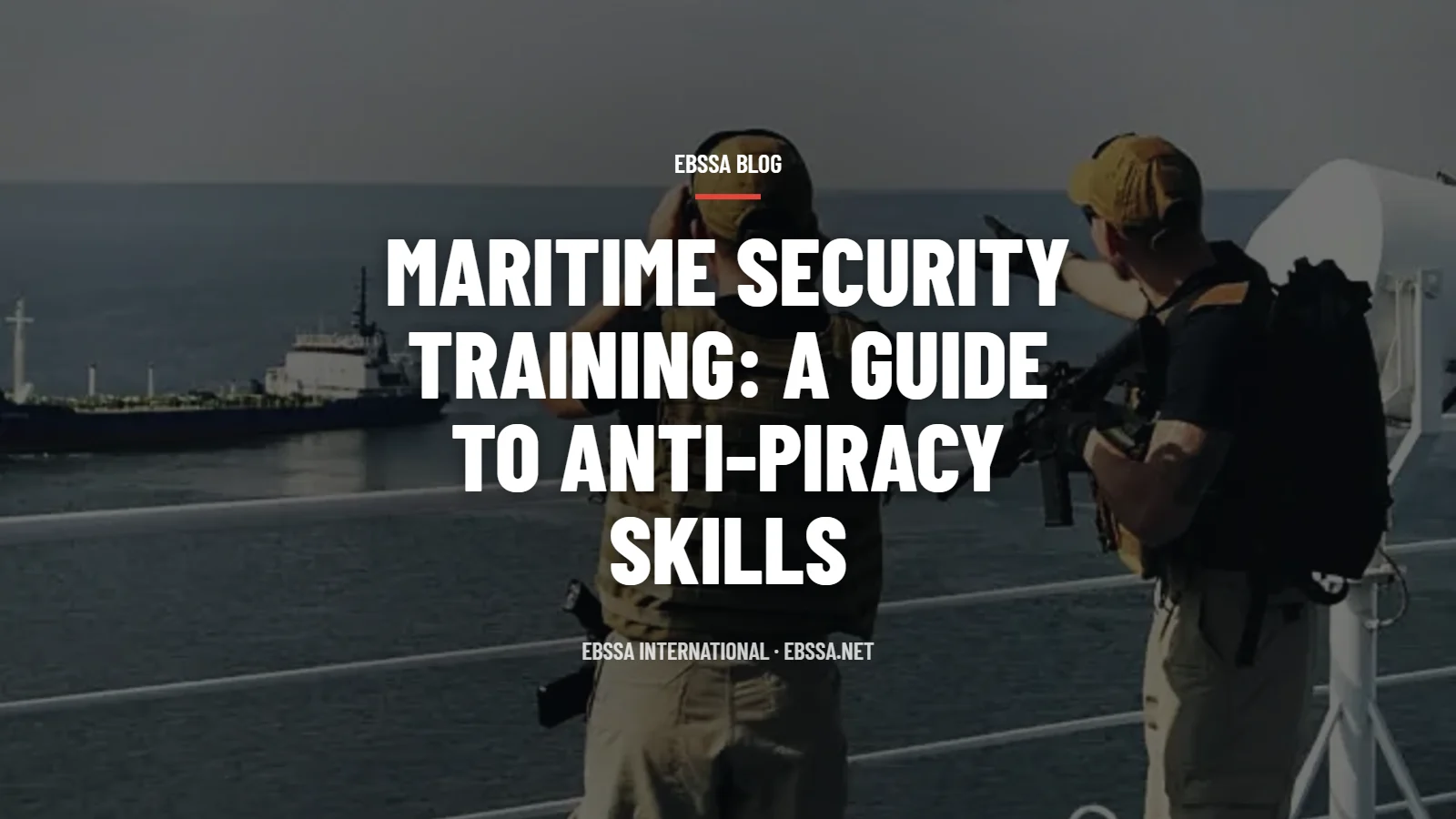
Commercial shipping still moves most of the world’s trade, and some of its busiest routes pass through waters where piracy, armed robbery and other threats to vessels remain a real concern. That is why shipping companies and maritime security providers look for operators with solid maritime security training: people who can protect a ship, its crew and its cargo without putting the voyage at greater risk. This guide explains what that training covers, which certificates matter, and how to choose a course that prepares you for the job.
What is maritime security training?
Maritime security training prepares security personnel to work on board merchant vessels, usually as part of a small embarked team. The role is often called maritime security operative (MSO). In practice, an MSO is a mix of security professional, lookout, adviser and, if everything else fails, armed defender.
Good training does not treat the ship like a patrol base on land. A vessel has its own chain of command, its own safety rules and a master who keeps overall authority. Security teams work for the voyage, not around it, so the training has to combine firearms and tactics with seamanship basics, safety at sea and a clear understanding of the legal framework.
Core skills in anti-piracy training
Threat recognition and watchkeeping
Most attacks are prevented long before anyone fires a shot. Operators learn to keep watch from the bridge, use optics properly, read radar contacts together with the bridge team and tell the difference between normal fishing or trading traffic and a suspicious approach. Speed, heading changes, the number of people on board a small craft and visible equipment such as ladders all matter.
Ship hardening and passive protection
A large part of the job is advice. Before entering a high-risk area, the team helps the master and crew prepare the vessel: razor wire, secured access points, a protected citadel or safe muster point, and communication plans. Industry guidance on these measures has been published by shipping associations for years; the current consolidated version, BMP Maritime Security, was released in 2025 and replaced earlier regional editions such as BMP5. A trained operator knows this guidance and can explain it to the crew in plain language.
Rules for the use of force
Armed guards on ships work under strict rules for the use of force. Training covers graduated response: making the ship’s presence and protection visible, warning signals, warning shots where permitted, and only then proportionate force as a last resort. Every step has to be documented. An operator who cannot explain why and when they would escalate is a liability to the ship owner, not a protection.
Maritime firearms skills
Shooting from a moving deck is very different from shooting on a static range. Training includes weapon handling in confined spaces, shooting positions behind cover on deck, safe storage and transfer of weapons, and the drills required for a maritime firearms competency assessment. Weapon safety is constant, because a vessel is a workplace full of crew who are not soldiers.
Medical response at sea
A ship may be days away from a hospital. That makes trauma care a core skill, not an extra. Courses usually include tactical combat casualty care (TCCC) principles: bleeding control, airway management, casualty evacuation inside the ship and handover to medical support when it becomes available.
Certificates employers ask for
Shipping companies and maritime security providers set their own hiring requirements, but a few documents appear again and again:
- STCW basic safety training: the international seafarer standard covering personal survival techniques, fire prevention and firefighting, elementary first aid, and personal safety and social responsibilities.
- ENG-1 or an equivalent seafarer medical certificate: proof that you are fit to work at sea.
- Ship security awareness and knowledge of the ISPS Code: the International Ship and Port Facility Security Code is the regulatory framework for security on ships and in ports.
- Maritime firearms competency: documented, assessed weapon handling to recognised standards.
- Medical training: TCCC or a similar trauma care qualification.
Companies that provide armed guards often work to ISO 28007, the standard for private maritime security companies, and they expect their operators’ training to support that. No certificate guarantees a contract, but missing documents will rule you out quickly.
Who maritime security training is for
Many operators come from the military, police or land-based security work. Their tactical background helps, but they still need the seafarer certificates and the maritime-specific procedures. Newcomers to the industry can also start here, provided they are physically fit, disciplined and ready for long periods at sea with a small team.
Maritime work also combines well with land-based roles. Many contractors alternate between ship protection and assignments ashore, which is why skills such as hostile environment awareness training (HEAT) or hostile environment close protection are useful additions to a maritime profile.
How to choose a maritime security training course
Course descriptions often look similar. These questions help you see the difference:
- Does it include the seafarer certificates? A course that covers STCW, the medical certificate and ship security awareness saves you from collecting them separately.
- How much time is spent on the range and in scenarios? Classroom theory is necessary, but boarding-attempt scenarios, deck positions and live-fire drills are where the skills are built.
- Who are the instructors? Look for instructors with real maritime security and military experience, including team leader roles at sea.
- Is the use of force taught seriously? Rules for the use of force, reporting and legal responsibility should be a full part of the programme.
- Is medical training included? Trauma care should be hands-on, not a short presentation.
- Is the provider accredited? Check the provider’s accreditations and how its certificates can be verified.
- Is the provider honest about jobs? Be cautious with anyone who promises guaranteed employment. Hiring decisions belong to the shipping and security companies.
Maritime security training at EBSSA
EBSSA International is an accredited training provider with the UN and NATO and has trained security professionals since 2014. Our Maritime Security Operative course brings the main requirements together in one programme: STCW basic modules, the seafarer medical certificate, ship security awareness, the ISPS Code, tactical shooting for maritime firearms competency, and TCCC.
Training runs in small groups with instructors who have served as Special Forces operators and maritime security team leaders, and most of the time is spent on the range and in realistic scenarios. Graduates receive the EBSSA International certificate. If you also plan to work ashore, the Private Military Contractor course covers the land-based side of the profession.
For upcoming course dates and fees, see the course schedule.
FAQ
Do I need military experience to start maritime security training?
No. Military or police experience helps, but motivated newcomers who are fit and disciplined can start with a complete maritime security operative course. Employers will still look at your overall background when hiring.
What certificates does a maritime security operative need?
Typically STCW basic safety training, a seafarer medical certificate such as ENG-1, ship security awareness with knowledge of the ISPS Code, a maritime firearms competency qualification and medical training such as TCCC. Individual companies may add their own requirements.
Does a maritime security course guarantee a job on a ship?
No course can guarantee a contract, because shipping and security companies make their own hiring decisions. Good training gives you the certificates and practical skills they ask for, which is what makes your application competitive.